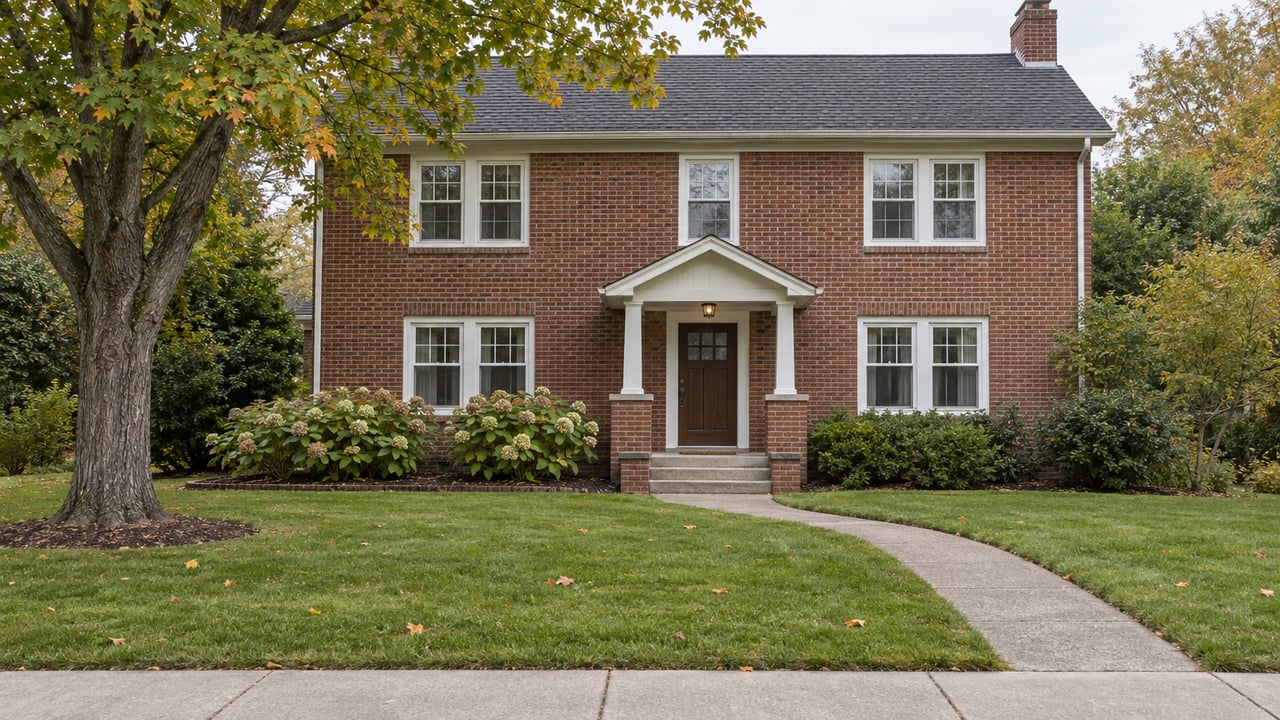
Picture two homes the Lawrence County Auditor values the same. Both are in Fairland Local Schools, and both are a short drive from the bridge into Huntington. On the county's 2025-pay-2026 rate sheet, the one inside the village of Proctorville carries an effective residential tax rate about 27% higher than the one out in Rome Township. Outside the village, school taxes also work differently from what most Ohio property tax explainers describe, because Fairland sits right at the state's 20-mill floor. If you're comparing homes on the Ohio side of the river, those two facts shape the tax line on a listing more than the asking price does.
Start With the Line on the Auditor's Map
Ohio taxes property by "tax set," meaning the particular stack of county, township, school, village, and joint vocational school levies that covers a parcel. The Lawrence County Auditor's tax rate summary for 2025 pay 2026, dated February 23, 2026, lists three tax sets that all send their school millage to Fairland.
| Tax set on the 2025 pay 2026 sheet | School mills | Village mills | Total gross mills | Effective residential/ag rate |
|---|---|---|---|---|
| Rome Twp, Fairland S.D. | 20.000 | 0.000 | 33.400 | 29.610365 |
| Union Twp, Fairland S.D. | 20.000 | 0.000 | 32.900 | 29.417542 |
| Union Twp, Proctorville village | 20.000 | 10.600 | 41.800 | 37.466492 |
All three have the same school millage. The village column makes the difference. Inside Proctorville, the effective rate runs about 7.9 mills higher than the Rome Township–Fairland set and about 8 mills higher than the Union Township–Fairland set. The county's own records put the village in a Union Township tax set, so an address that reads "Proctorville" in a listing doesn't tell you which row applies. The parcel's tax set does.
The effective rate is the number to compare, because the gross rate overstates what voted levies actually collect.
What the Village Millage Pays For, and What's on the November Ballot
The 10.6 village mills fund village services, and some of them come up for renewal on November 3, 2026. According to the Ohio Secretary of State's local questions and issues file, published September 18, 2026, three renewals affect the Proctorville area.
- Village of Proctorville: 2.5 mills for current expenses, five years, starting 2027
- Village of Proctorville: 1.5 mills for fire protection, five years, starting 2027
- Rome Township: 1 mill for fire and EMS, five years, starting 2027
All three continue levies that are already on the bill, so passing them keeps the current rate in place rather than adding new millage. The issues file lists no Fairland Local Schools levy for this election. If you're buying this fall, the tax rates you see now are likely to hold through the vote. The listing on the ballot is time-sensitive, though, and certified results will replace it after the election.
The 20-Mill Floor Is Why Rome Township's Value Jump Reached the School Line
Most Ohio guides say rising home values don't raise voted levies, and in general that's correct. Under the state's HB 920 system, a tax reduction factor trims qualifying fixed-rate voted levies after a revaluation so they collect about the same total as before, according to the Ohio Legislative Service Commission. Inside millage, the unvoted portion shared among local governments, is not trimmed. Debt levies and fixed-sum levies aren't either.
Schools have one more limit. The LSC explains that the 20-mill floor caps how far reduction factors can cut a school district's fixed-rate levies. Once the floor binds, rising values can raise some school taxes, and owners whose own values rose the most can carry more of the increase. Fairland's school rate shows as exactly 20.000 mills on the county's rate sheet, which puts it at the floor.
That matters because Rome Township values just moved. In the tax-year 2025 triennial update, the Auditor's district chart shows residential and agricultural values in Rome rising 20.29% on average. Rome had no state equalization order, so values were set from sales in each neighborhood. The Auditor cautions that individual parcels moved more or less than the average and that "changes in property value do not necessarily result in proportional changes to property taxes."
Put those together and the usual guide advice doesn't hold for a Rome Township–Fairland parcel. The HB 920 cushion protects much of the bill, but the school portion sits at the floor, and that's where appreciation can show up.
The Credit That Appeared on July's Bills
Ohio's legislature responded to exactly this situation. HB 186 created an Inflation Cap Credit for school districts where the 20-mill floor applies, limiting floor-driven growth to the rate of inflation. The Lawrence County Auditor's office under Paul David Knipp says the credit first appeared on the 2025 second-half real estate bills, mailed July 9, 2026. For Fairland, the residential and agricultural credit is $19.03 per $100,000 of market value. On a home the Auditor values at $250,000, that comes to about $48 on that bill. The Auditor also notes that if an owner paid before the credit was applied, the overpayment carries forward to the 2026 first-half bill.
That timing matters for anyone reading a listing this fall. A tax figure pulled from the first-half 2025 bill won't show the credit. A figure from the second-half bill will. You can look up a parcel's bills through the Lawrence County Treasurer.
A second change applies to owners who already receive the homestead exemption. HB 479, effective September 23, 2026, gives those owners a one-time reduction for tax year 2026, applied to bills payable in 2027. It also calculates the homestead exemption before the Inflation Cap Credit, which increases the exemption for eligible owners starting in tax year 2026. Because that reduction is tied to the current owner's homestead status, a seller's 2027 bill may reflect a benefit that doesn't automatically carry over to the next owner.
What the 2026 Law Package Changes Before the Next Reappraisal
The Auditor describes a six-year cycle: a full reappraisal, then a triennial update three years later. The county's most recent reappraisal was in 2022 and the update in 2025. On that schedule, the next full reappraisal falls in tax year 2028. Several laws signed December 19, 2025 and effective March 20, 2026 will shape what that reappraisal does to bills:
- HB 335 requires county budget commissions to adjust inside-millage collections during a reappraisal or update so that growth doesn't exceed the GDP deflator over the prior three years. This targets the portion of the bill HB 920 never protected.
- HB 129 changes which levies count toward the 20-mill floor. Current-expense fixed-sum levies enter the floor calculation beginning in tax year 2026, which matters for a floor district like Fairland.
- HB 309 expands budget commissions' authority to adjust levy collections, with limits that include protections for prior-year collections and a 20-mill floor safeguard.
- HB 124 changes the state's review of county appraisals. It requires the use of county auditor sales samples, limited to open-market, arm's-length sales from the previous three years.
Separately, HB 96, the 2025 state budget, eliminated replacement property tax levies, after lawmakers overrode a veto. HB 186 also raises the owner-occupancy credit while phasing out the nonbusiness credit. A Tucker Ellis summary describes that credit rising in stages from 2.5% to 15.38% by 2029.
For a Fairland homeowner, the floor is still the main mechanism. These laws change how much a revaluation can push through it, starting with the bills that follow the 2028 reappraisal.
Reading a Listing's Tax Line Around Proctorville
All of this points to a few specific checks when you compare homes on the Ohio side:
- Tax set: A Proctorville mailing address can sit in the village tax set or in a township set, and the village set carries about 8 more effective mills.
- Which half-year bill: First-half 2025 figures come before the Inflation Cap Credit. Second-half figures include it.
- Owner-specific credits: Homestead and owner-occupancy credits depend on who owns the home and how it's used, so a seller's bill reflects that seller's situation.
- Value change at the 2025 update: In a floor district, a parcel whose value rose more than the Rome Township average of 20.29% can carry a bigger share of the school tax change.
A Few Direct Questions
Can a homeowner contest the value the Auditor set?
Lawrence County uses a Board of Revision process. The Auditor's general text gives a January 1 to March 31 filing window. The tax-year 2025 complaint listing covers filings from January 1, 2026 through April 10, 2026.
Did HB 186 change my home's appraised value?
No. The Auditor says HB 186 changed how certain taxes and credits are calculated. It didn't change appraised values.
Does the new construction on a lot fall under the HB 920 cushion?
The LSC explains that HB 920 applies to carryover property. New construction and improvements, along with new voted millage, can affect taxes outside that baseline.
If you're weighing a home in Proctorville, Rome Township, or across the river in Huntington, Impact Realty Group can pull the parcel's tax set and recent bills so you can compare the real tax line before you make an offer. Selling on the Ohio side? Get your free home valuation, and we'll show you how your tax set and credits will look to buyers.
This article is general information, not legal, tax or financial advice. Consult a qualified professional about your situation.